

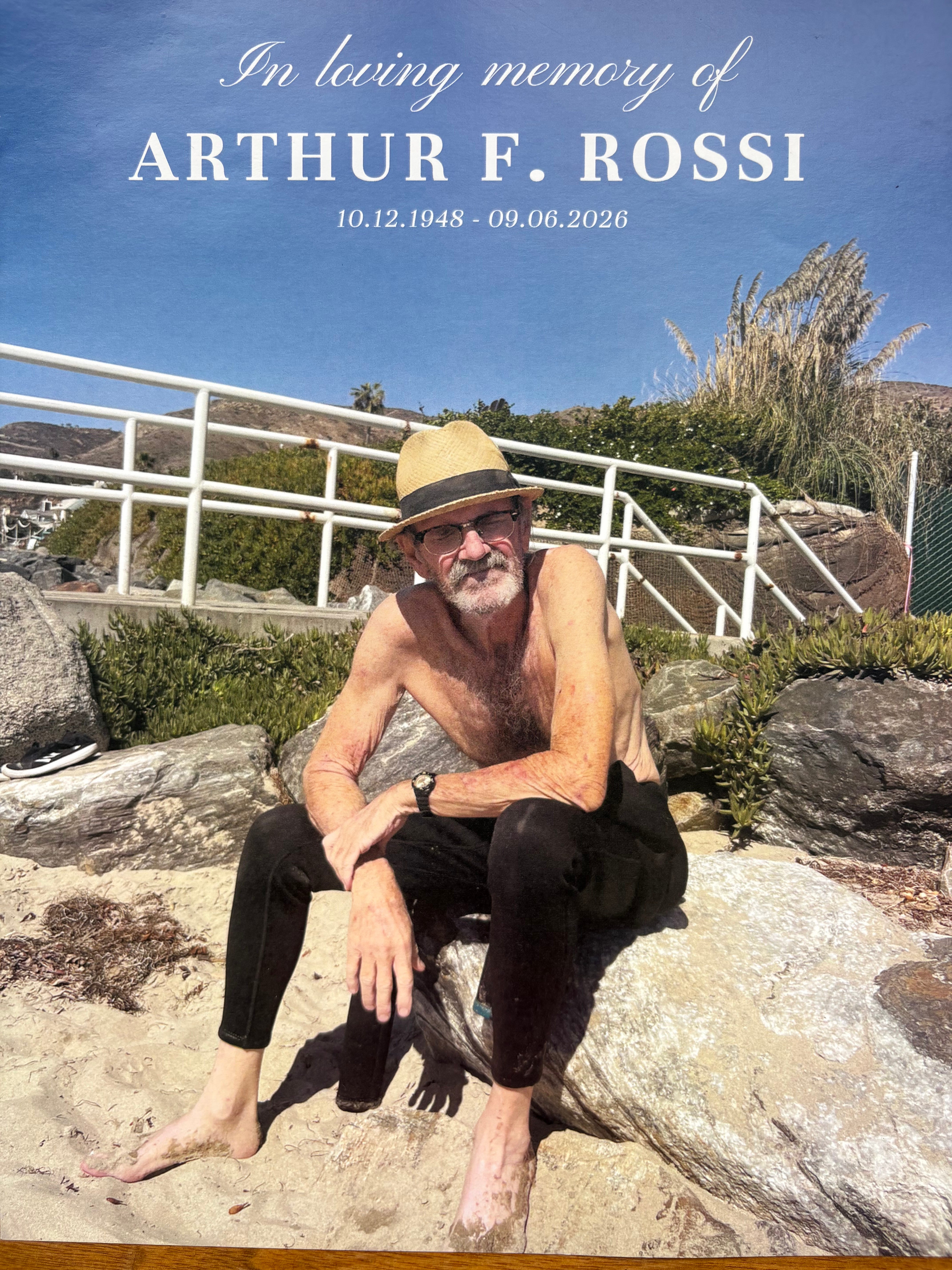
My dad passed away a month ago after a long and courageous battle with cancer. I haven’t written here since. I haven’t written anything since, not even a post-it note. Every time I sat down, he was the only place I knew how to start. So I’m starting there. Coming back to life is how we honor the people we lose, and my papa would want me back at it. So, hi. I’m back.
Soon I’ll be back to the things I’d normally call my dad about: You Can See Everything, and why Billy Evans is the scariest man alive in that movie but especially this recent podcast !
When you’re grieving, people tell you things, and you hold on to them. “They say the righteous pass away before the new year.” “Welcome to the worst club in the world.” And the answer from my own tradition: “May his memory be a blessing.”
That club is real. The grief is real, and so is the relief. That’s ok too! The club is made up of the most random people: an acquaintance, a friend of a friend, someone you haven’t talked to in years. And all of them become your people. If you’re in this club too, I see you. And if you’re not yet, I hope this finds you when you need it.
I’m not going to teach you how to handle grief, because I don’t quite know. These two books were given to me for a reason and the season I’m in .


But I’ll say this: never ask someone who’s grieving “How are you?” That is an insane question! Get specific. Or just show up with food and love. And don’t be afraid to be light and make them laugh.
Below is the eulogy I gave at his funeral, shared the way I said it.
My dad was obsessed with history. You remember that TikTok trend, where you’d ask the men in your life how often they think about the Roman Empire? On one of his twenty-six trips to the hospital, I asked him. He said, “all the time” — and he meant it. He loved understanding how civilizations were built; he’d stop mid-sentence just to tell me Sicily had been conquered seven separate times. And I couldn’t believe it — I guess I couldn’t, because at the time, I didn’t care. But history was everything to him. To my dad, history was the story of the creation of the world, and that was his sense of awe. So let me share a little of his.
We’re here today because this is where his mother, Alice Rossi, is buried, alongside her father, James Joyce, who came from Ireland during the potato famine. His father, Arthur Rossi Sr., was from San Marino — its own country, my dad loved to point out, separate from Italy — and made his way to Long Beach.
History, to him, was really about language — the stories people pass down, and how far you can carry them forward. He spoke many languages himself, breaking into Spanish whenever it wasn’t even needed, which used to embarrass me. I understand now that was his gift to me — and even in his passing, he’s still teaching me new ones. This week, and every week from now on, I’ve learned the language of grief — how it’s simply unexpressed love, and how much comfort there is in connecting with other people over their own. He’s opened up a whole new curiosity in me: not just the history of empires, but the history of people.
I’ve also learned the language of cancer — how to talk to doctors and nurses, how to navigate this world of healers. Thank you to UCLA and Dr. Wainberg, and to my friend Simone, here today, who connected us to the Robert G. Kardashian Center for Esophageal Health. He was given the best doctors, and he outlived everyone in his trial — a fact he loved to tell people.
And most important, I learned the language of the spiritual realm. My faith tells me he isn’t gone. I talk to him now and ask him for a sign, as a star — and I’ve received one every single time. That’s our newest language: him, as my angel and my protector, above.
My dad told me every day how proud he was of me, how much he loved me, how beautiful I was. He was proud of my brother Nathan, for his hard work and his deep faith. Proud of my brother Noah, for his depth, and his new life with my new sister, Maya. He was grateful he married my mother, into a huge Moroccan Jewish family, and grateful for Barbara, and their third-act love — proud of her kids too: Pearl and Michael’s touring, Sophie’s promotion, Frank for his political passion, and Zelda’s job at Annapurna. I couldn’t believe he even knew what Annapurna was.
For eight years, he courageously fought cancer, and I had the honor of being his caretaker — the way I’d watched my mother care for her parents, and my father care for his. It felt like an ancestral duty, the duty of children of immigrants. People often told me what a good daughter I was, and I could never quite accept it — some part of me was afraid that if we lost this fight, I wouldn’t get to be that good daughter anymore. So instead I just focused: every infusion, every hospital visit, every round of radiation. Worrying about my dad became my full-time job — quite literally.
A week before Rosh Hashanah, when we’re meant to return to our truest selves, my father passed — at the exact moment I was at peace. I was with my friend Erin and her new baby that night. I told her I thought I’d take the night off from visiting him, and she said, “What if tonight was the night?” We laughed so hard, the way only friends like sisters can. Half an hour later, it was the night. I know that in that moment, my father let go because he knew I was happy — he knew I was speaking the language of new life.
We have a custom of saying, “may his memory be a blessing.” This truly is one: I no longer have anyone to worry about. I only have his love and his strength to live by, and to honor — surrounded by all of you, family and community, who came from so far to be here. So many of my friends are here today because of how they’ve shown up for me, and that truly means the world to me. My father left this world leaving me one more gift: the gift of receiving love. We’re not just measured by how much we give — we’re measured by how we allow ourselves to receive.
Losing a parent is the natural cycle of life, but it still leaves you feeling untethered. My friend Miriam, and our rebbetzin, told me something from our tradition I didn’t know: that at any age, when you lose a parent, you’re considered an orphan. It’s even in the name of the prayer we say for him — the Mourner’s Kaddish is called Kaddish Yatom, the Orphan’s Kaddish, no matter how old the child saying it is. And the same Torah that commands us to honor our parents commands us to look after the orphan. So when I look out at this room, I don’t just see people who came to comfort me — I see people keeping a promise: honoring my father by taking care of me, and letting me receive it. I don’t take that lightly.
And although I’m no longer his caretaker, I’m now the caretaker of the thing he loved most — me, his daughter. So I get to take care of me, the way he always did. And I get to vow, every day, to be the best daughter I can be. That is his gift to me.
So today, as we step into this new year, I wish that same gift for all of us — the one he left me without meaning to: knowing how to receive, not just give — a sweet new year, where we find comfort, and where we celebrate, together.
Dad — I love you, my daddy, so much, forever and ever. Mon papa adoré. You were my favorite hang.
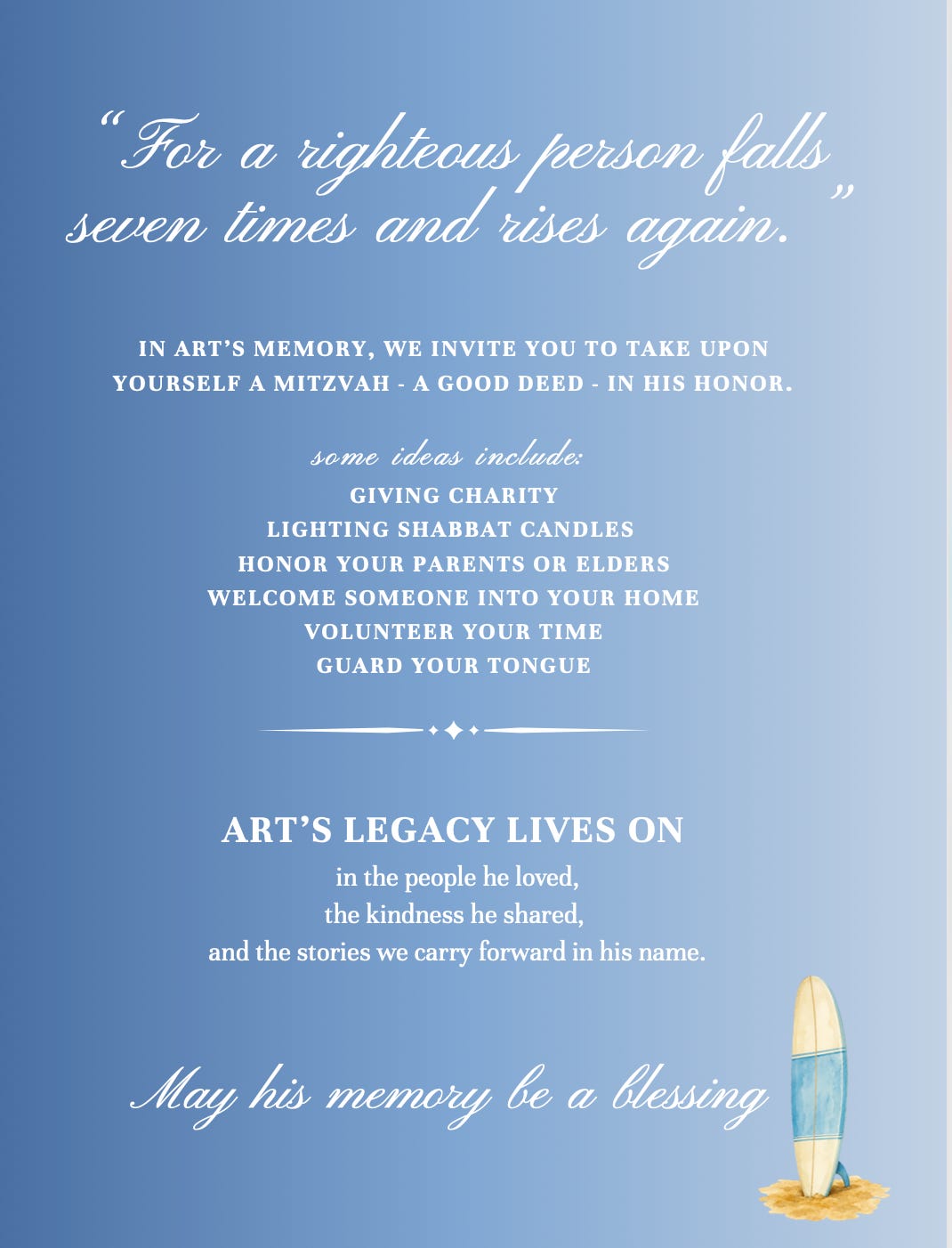
If you’ve lost a parent, I’d love to hear about them in the comments. I guess I do love history now!
How beautiful this is.
This is so raw and beautiful. And incredibly valuable. I love you.